Monday, September 24, 2018

LA JOLLA COAST AND COVE


LA JOLLA COVE

It is always enjoyable to walk along the La Jolla coastal cliffs and look down on the cove, beach and rocks below.  The sea lions and seals may be seen basking on the sand or rocks.  They can be quite active and vocal as well to the delight of  visitors.

The most obvious difference between sea lions and seals is that sea lions have external ears.  Sea lions also have larger and stronger front flippers that enable them to “walk” and climb up cliffs  which is why they’re so visible around La Jolla Cove. Seals move around on land by wiggling on their stomachs. They have smaller, webbed front flippers. Sea lions are brown and seals are darker grey, brown or almost black with speckled skin. If you hear barking, that’s definitely a sea lion. Seals are only capable of low grunts. Seals are typically solitary animals but you will see them in large groups here in La Jolla. Sea lions often pile up next to each other.


Tuesday, September 18, 2018

SAN DIEGO BAYFAIR POWERBOAT RACES 2018


San Diego Bayfair is a world series of powerboat races  on Mission Bay.
It  has a long and rich tradition in Mission Bay Park. The first race was staged in 1964 thanks to the foresight of the great Unlimited hydroplane racer Bill Muncey. Muncey was the driving force behind Bayfair and getting the racecourse built to host the event.


The 2.5-mile racecourse, which was named after the late Bill Muncey, is the longest and fastest racecourse on the H1 Unlimited hydroplane circuit. Driver Dave Villwock set the World Lap Speed Record of 173.384 mph in 1999 at Bayfair. Villwock has won a record nine Bill Muncey Cups, including his first ever Unlimited hydroplane race victory on Mission Bay.


The photos of the powerboats were taken from Mission Bay Campland which has a nice beachfront.

Wednesday, July 4, 2018

WALKABOUT AUSTRALIA


Walkabout Australia is the newest addition to the San Diego Safari Park.
It is designed to represent Australia’s rural landscapes, animals, plants and signs of human habitats along back country roads.
 One walks along a path in a grassy habitat where one may encounter gray kangaroos and red-necked wallabies.

A stream flows into a large pond where one may find magpie geese.
There is a large Zuest Station building to represent the wool sheep shearing sheds found on many of Australia’s sheep ranches.  Techniques of wool processing are exhibited. Snacks are available as well. 
Future  additions to the exhibit will include the Cassowary bird and other Australian inhabitants.
THE BAJA GARDEN IS ON THE TRAIL AFTER VISITING THE WALKABOUT
Nearby attractions include the Condor Ridge with Condors and a few other birds along the trail.
CONDOR


There is a good view of the Safari Park from an overlook.


AN AMERICAN EAGLE IS ON EXHIBIT ALONG THE TRAIL NEAR THE CONDORS


Friday, May 18, 2018

80th BIRTHDAY


My family treated me to a special birthday dinner at Juniper and Ivy which is located at the north day of Little Italy.  The menu features many small plates which are fun to share with a group .


GOLD AT SAN DIEGO MUSEUM OF ART


Nancy Lorenz: Moon Gold is the first major solo museum exhibition to showcase the art and alchemy of New York-based Nancy Lorenz. Having trained in the conservation of Japanese decorative arts, Lorenz continues to employ traditional lacquering and gilding techniques as points of departure in her studio practice. This collaboration with the Museum will features new works by the artist inspired by Japanese masterpieces from the permanent collection.
Among the painted works in the exhibition will be what Lorenz calls Pours, abstract compositions involving gestural applications of water-gilded gesso. Varying in scale, these paintings turn on the tension between arid fields of pigment and sumptuous cascades of gold, silver, and platinum. More intimate, though no less beguiling, will be a group of decadently adorned boxes.
Elsewhere, corrugated cardboard is transformed into a ground for gilding. Abstract scratches and striations coalesce into a landscape composition, an evocation of sea, sky, and slanting rain. This motif, studied from nature in the artist’s sketchbooks, remains a recurring theme in paintings large and small, and in the panels that together form folding screens.


We also visited a gallery at the art museum that featured paintings by American artists.
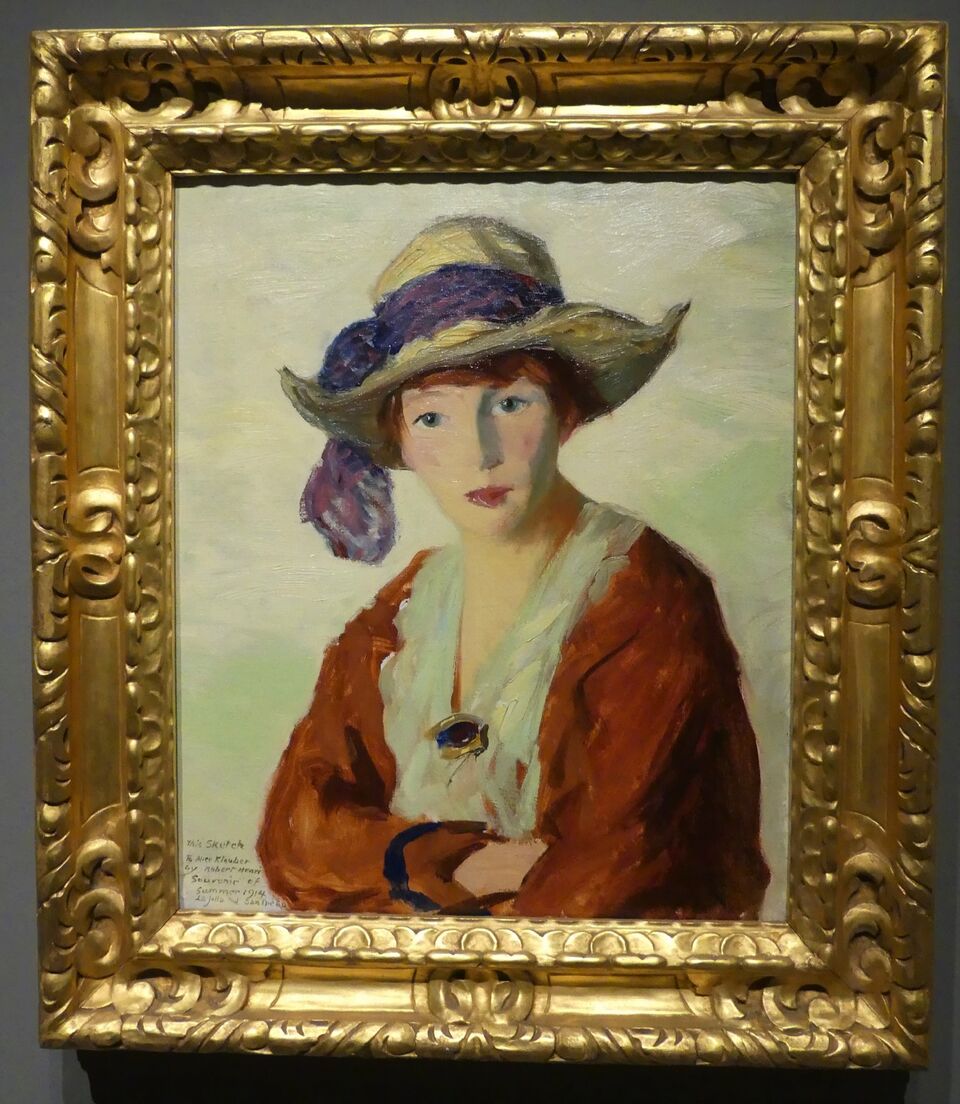
Portrait of Mrs. Henri by Robert Henri

painted by Mary Cassalt
Below the Towers of Towers Falls, Yellowstone Park  by Thomas Morgan

                                   A bougainvillea in full bloom near the Museum of Art.

Thursday, May 17, 2018

AFRICA ROCKS AT THE ZOO


Africa Rocks spotlights the animal and plant diversity on the African continent and is the newest experience at the zoo.  The area is divided into several geographical sections.
Colorful drought resistant flowering ground cover plant in Africa Rocks
Closer look


We saw a Bateleur Eagle at the top of the Africa Rocks canyon.

The Hyraxes live in rock formations.  Their footpads act like suction cups to help get a grip.  They are related to the elephant!

Hamadryas Baboon


The baboon exhibit has the largest area with a good part of the canyon forming the Ethiopian Highlands section.  The Hamadryas Baboons have a large group that stays together and spends the day foraging. 

The Nubian Ibex are known for their impressive horns and are members of the goat family.  

Ring-tailed lemur


   Several species of lemurs are in the Madagascar forest section.  

West African Crocodiles are found in West African forests. How to tell a crocodile from an Alligator?  Crocodiles have a V shaped snout and alligators have a U shped snout.

\\
      The Acacia woodland is a haven for many animal species. Monkeys use the trees and scamper on the ground, birds perch and nest among the branch canopies and big cats lounge in the shade.
      A large aviary is part of the Acacia woodland.  Some of the featured birds include bee-eaters and the black-headed weaver.  The weaver builds  a hanging nest that it hovers around to attract a female.
Black Headed Weaver
     The Fischer’s Lovebirds have green backs with orange heads and a flaming red beak.
This colorful bird caught our attention
  An African Pygmy Goose is nestled in a large bowl.

A leopard is resting in the Acacia woodland of the African savanna
Cape Fynbos is located on the South Africa coast where the African Penguins live.  In this enclosure at the bottom of the canyon they enjoy a large pool and a rocky beach.