Friday, September 9, 2016

LA JOLLA SHORES WALK


La Jolla Cove
Paul and I enjoyed a walk along the La Jolla coastal path that hugs the cliffs with scenic views of the ocean. There is limited access to some of the beaches below. 


The Children’s pool is a small cove protected by a concrete breakwater wall. It was originally built as a safe swimming area for children but was claimed  long ago by harbor seals who beach themselves on the sand with their young. The area is closed for swimming now and offers a view of these marine animals. The seals are so used to people that they show no fear of approaching visitors


The seals are so used to people that they show no fear of approaching visitors


 The path continues past Ellen Browning Scripps Park which is a popular picnic spot with a  grassy area with large trees. We watched a gentleman there making soap bubbles with an extended wand.


La Jolla Cove is a picturesque swimming spot that is frequented by open water swimmers and divers. Beyond one can often see kayakers from La Jolla Shores.


Looking towards La Jolla Shores

LIVING COAST DISCOVERY CENTER


            The Living Coast Discovery Center is on the Chula Vista bayfront. It showcases the wildlife of San Diego’s coastline. The center is adjacent to a wildlife preserve with trails throughout the habitat.  The center began as a nature intrepertive center in 1987 by the Bayfront Conservency.  Later it was funded by the city of Chula Vista and it became independant in 2012.

Some of the aquatic and terrestrial exhibits include  Eastern Pacific green sea turtles.  There are four turtles in an open-air aquarium. 


A larger aquarium is home to Manta Rays and local Leopard Sharks 


                                                                                   An indoor tank showcases a pacific Octopus. 


 Other tanks have fish, starfish and other aquatic specimens.


This colorful chameleon was of special interest.


The center is a birdwatchers delight with egrets, sandpipers, lightfooted clapper rails, least terns, owls, hawks etc.

Thursday, September 8, 2016

LABOR DAY 2016


Two events took place on the embarcadero of San Diego Bay during Labor Day
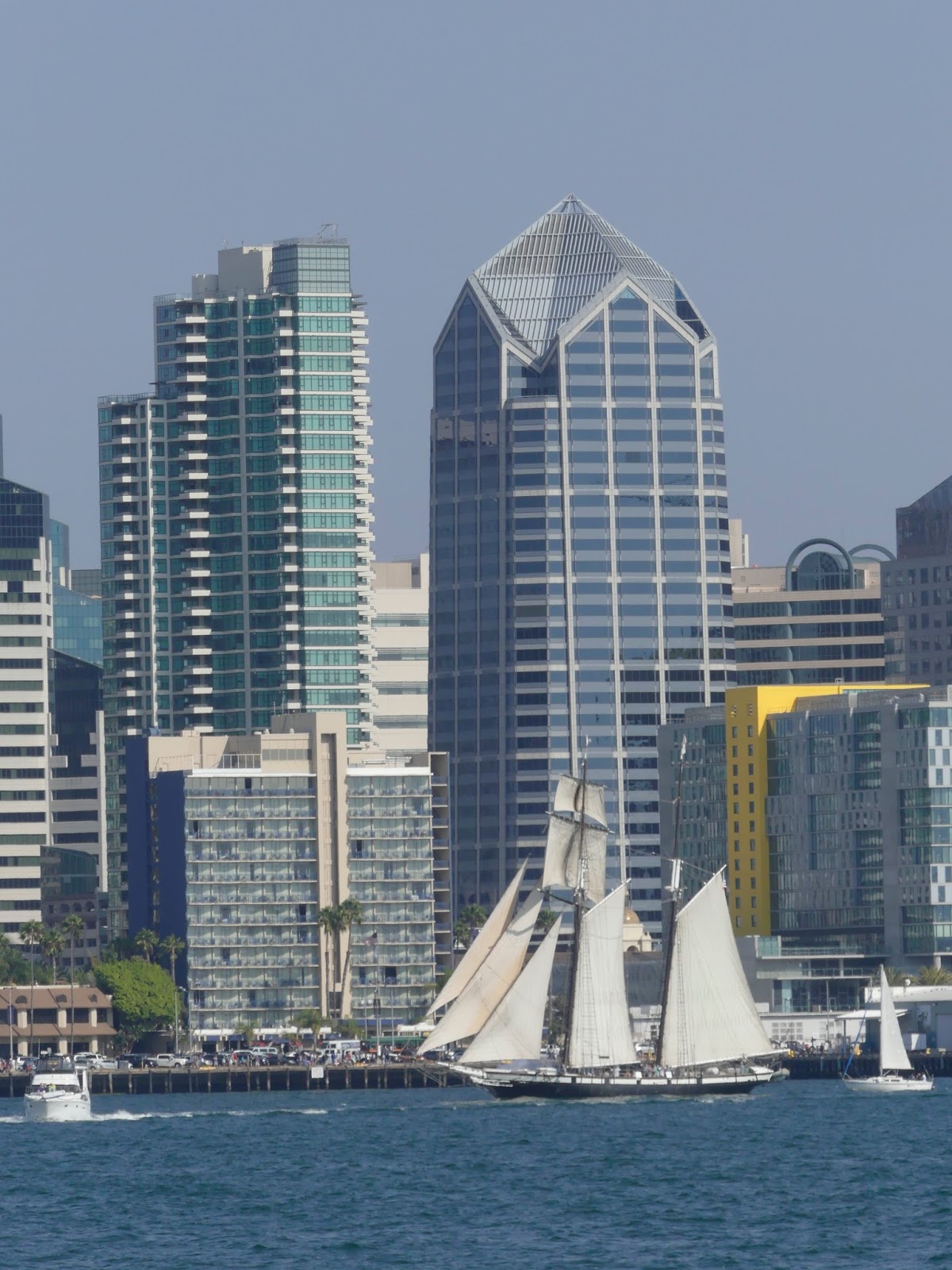
The Festival of Sail is an annual celebration of tall ships  which takes place at the Maritime Museum of San Diego during the Labor Day weekend. This year it included 19 ships from several West coast locations.  It is the largest tall ship festival on the west coast.  The festivities included some mock cannon battles.


The Californian was built in 1984 at Spanish Landing in San Diego Bay and was launched with great fanfare for the 1984 Summer Olympic Games in Los Angeles. In July 2003, the Governor signed a bill into law designating the California as the official tall ship of the Sate of California.  She is the only ship to carry this title. It is a replica of the 1847 Revenue Cutter C.W. Lawrence, which patrolled the coast of California enforcing federal law during the gold rush.


Another festival ship was the Claudia built in Norway
The San Salvador is a replica built recently at the Maritime Museum of the original that arrived in San Diego in 1542 under the command of Juan Rodriguez Cabrillo which is considered the founding ship of San Diego and the Sate of California.


One of several mock battles


Another ship was The bill of Rights, a Gaff
topsail schooner constructed in 1971 in South Bristol, Maine.


The Star of India is the world's oldest active sailing ship on the Isle of Man in 1863.  The ship is one of the permanent ships at the Maritime museum


Watching all the activities

View from the embarcadero


Another event on the waterfront near the Maritime Museum was the U.S.  Sand Sculpting Challenge on the B Street Pier with participating artists from around  the world.

Nostalgia by Ilya Filimontsev of Moscow won 1st place


Alpha Waves by Fergus Mulvaney of Dublin Ireland won 2nd place 


Wednesday, July 27, 2016

MONDAY NIGHT ORGAN CONCERT


During the summer in San Diego it is enjoyable to attend the Monday Night Spreckels organ concerts in Balboa Park to hear the world's largest outdoor organ.  We attended this one on July 18.
Passing out programs
Carol Williams, civic organist, introdues  Darryl  Robinson
Daryl Robinson at the organ

Guest organist Daryl Robinson 

Jason Ginter 
Jason is the principle timpanist for the San Diego Symphony
They are playing a Bolero


The moon on a cloudless night

The lighting director does for the eye what the organ does for the ear


Sunday, July 24, 2016

OLD TOWN SAN DIEGO


  •  Juan Cabrillo discovered the area where Old Town is today in 1543. In 1602 Sebastian Vizcano named it San Diego de Alcala.  A military post was established on Presidio Hill.


    By 1820 a small pueblo was developed below the Presidio using adobe bricks to build the homes.   Fiestas were held in the plaza.


    By 1846 the U.S. declared war on Mexico and a new constitution was written in 1849 and California was a state in 1850.  By then the American flag was raised in the plaza and San Diego was incorporated as a city.
    From 1868-1874 the San Antonio and San Diego Mail Line stage coaches came through San Diego.
    There were a series of misfortunes with fire, floods a severe earthquake.  In 1907 Spreckles bought the remains of  La Casa de Estudillo and started to restore Old Town


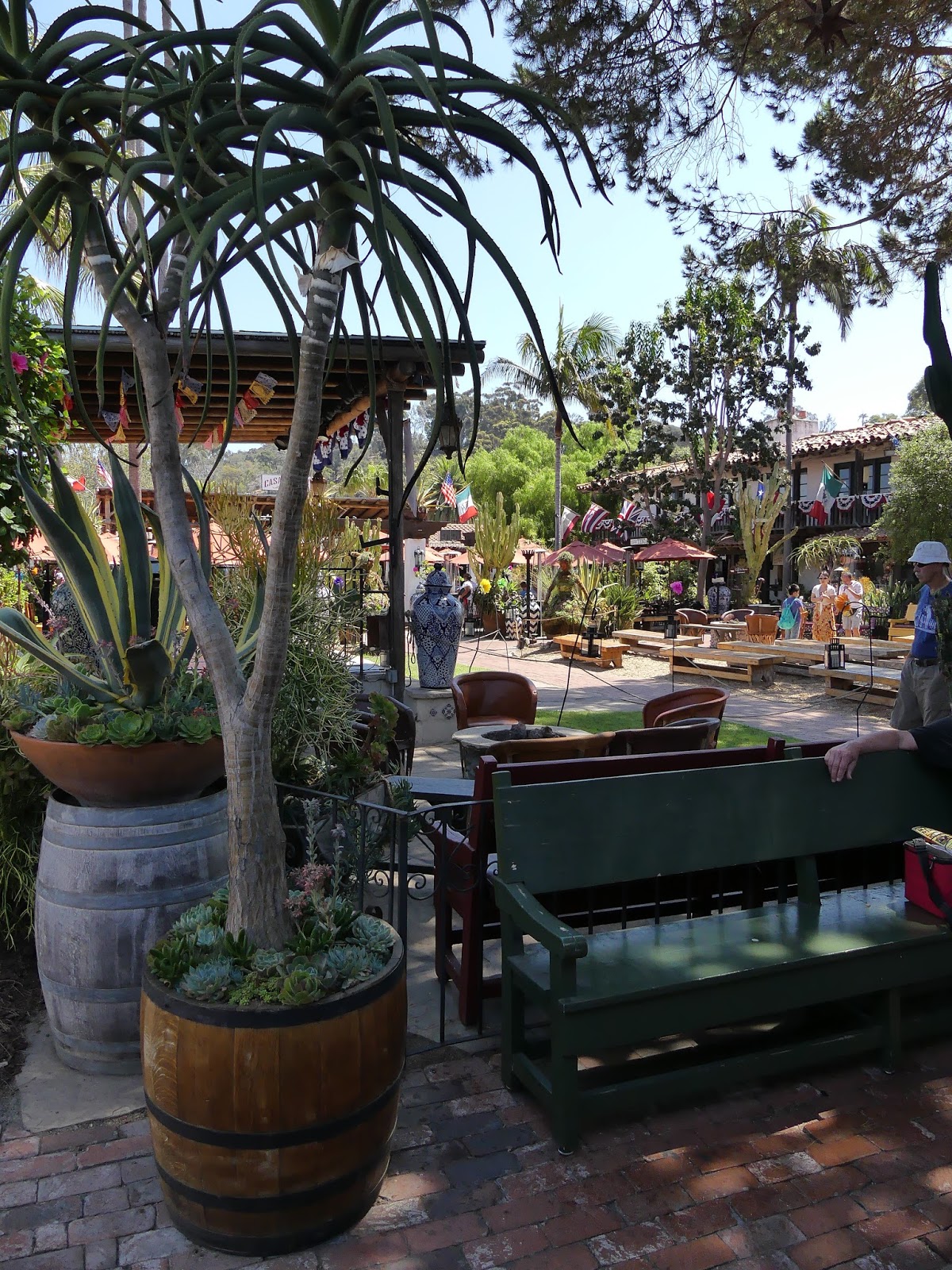
    Paul and I visited several of the restored adobe buildings around the plaza.  Many have small museums with docents who tell stories about the early history.  Some of the buildings are used for shops with merchants in period costume who provide a  peak into what life was like in the 1800’s. 
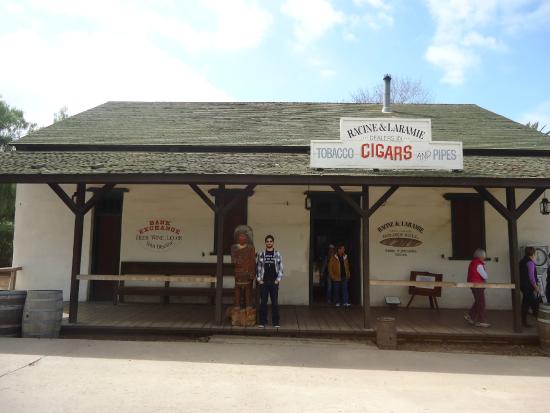
    The cigar shop had an interesting collection of historic pipes.


    The Wells Fargo Museum had early coins, a stage coach and mail route maps- click photo for details


    La Casa de Estudillo is a fine example of a home of a leading family of that era.  It  was built by Jose Estudillo with an inner courtyard with bedrooms,  servants quarters, a kitchen, storage rooms, a living and dining room and a chapel.  It was the social and religious center during the Mexican and early American periods.

    The docent at the blacksmith shop had many tools to demonstrate