The OAT Japan 2009 blog journal reads from most recent to oldest, if downloaded using the OAT Japan 2009 label tag. We have created this index page to enable the reader to peruse the postings in chronological order, and to read each posting as a separate Web page. Just click the links below, to access the individual posts:
Preliminary Planning For the Trip
March 18-20: Transition Time, California to Tokyo
March 21: Day in Tokyo
March 22: Tokyo to Gora, Hakone
March 23: Day Trip from Gora, Hakone
March 24: Hakone to Kanazawa
March 25: Day in Kanazawa
March 26: Excursion to Shirakawa-go & Gokayama
March 27: Kanazawa to Kyoto
March 28: First Full Day in Kyoto
March 29: Excursion to Nara and Fushimi-ku
March 30: Second Full Day in Kyoto
March 31: Arashiyama and Other Kyoto Highlights
April 1: The 48-Hour Return Home
Showing posts with label OAT Japan 2009. Show all posts
Showing posts with label OAT Japan 2009. Show all posts
Monday, May 4, 2009


Friday, May 1, 2009
OAT Japan, Wednesday, April 1, 2009:
The 48-hour Day Return Home (At Least It Seemed That Way)
We all had our last breakfast together at the Patio Restaurant, and said our goodbyes. A few of us were leaving early for a post trip extension to Hiroshima. However, they opted to do their own arrangements instead of purchasing OAT’s extension package. Perhaps we can share their experiences in future blog postings.


 After several fair days, it was raining this morning so we holed up in the hotel until our noon departure. Doug did some web surfing while Marie was looking at a temporary exhibit of designer kimonos (see photos).
The weather lifted as the van took us and the Denver travelers, John, Sally and Michiko, to Kansai International Airport, located in Osaka. We arrived about 2:00 p.m. for a 4:00 p.m. departure. Machiko arrived ahead of us to guide us through the check-in procedure. We then said our goodbyes and assured Machiko she was going to receive the highest ratings from us!
Kansai is a state of the art airport, completed in 1994. The designer was the world-renowned architect, Renzo Piano. The terminal was so well constructed that it came through the severe 1995 Kobe earthquake unscathed. Additionally, the place was spotless and the waiting area had free public computers for anyone’s use!
After exchanging the last few hundred yen for crisp American bills, we boarded the Boeing 747-400 for our flight to San Francisco International Airport (SFO). Whereas we had nice legroom with the bulkhead seating between LAX and Tokyo, this time we had little legroom at all. The food was adequate, but we did not feel that United’s service was as polished as on the earlier flight.
We tried to sleep for most of the flight, but we woke up a couple of hours before we were to land at SFO. We landed about 10 a.m., local time (it was still April 1 because of our eastbound crossing of the International Date Line).
Customs was quick and efficient, and since we had a four-hour layover at SFO before our final leg to LAX, we had a chance to have a light lunch and explore the terminal.
This terminal was a real letdown compared with what we experienced at Kanzai International, and even Narita. Maintenance was so shoddy in comparison: seat backs missing in the waiting areas, floors spotted with dirt and debris, unclean restrooms, out-of-order drinking fountains, and so on. We could not help wondering what kind of impression foreign visitors would leave with; is this the best the United States can do?
The last leg of our flight was a commuter hop to LAX that got us on the ground by about 3:30 p.m. Our last task was to hail a shuttle to the Hacienda at LAX Hotel. In the old days, one went to a bank of telephones to speed dial the hotel to send a shuttle van. Today, one uses a touch computer screen, to contact a van service. We panicked because the Hacienda was not on the menu! We asked an information official nearby; it turned out that the Hacienda shuttle made a regular run every 20 minutes and no contact was necessary. He directed us to the van pickup area just outside. Sure enough, a Hacienda shuttle came by within five minutes, and we arrived at the hotel lobby at 4:00 p.m.
We knew that the notorious Los Angeles rush hour was underway, and we were in no condition to attempt the drive to San Diego this evening. As noted earlier, we had booked an overnight stay just for this reason.
We were ready for a menu change, so we ordered hearty Mexican dinners at the Mariposas Restaurant. Thus sated, we turned in.
The drive home the next morning was a piece of cake; by leaving after rush hour was over, we made it home in two hours in a fairly alert condition.
We all had our last breakfast together at the Patio Restaurant, and said our goodbyes. A few of us were leaving early for a post trip extension to Hiroshima. However, they opted to do their own arrangements instead of purchasing OAT’s extension package. Perhaps we can share their experiences in future blog postings.


 After several fair days, it was raining this morning so we holed up in the hotel until our noon departure. Doug did some web surfing while Marie was looking at a temporary exhibit of designer kimonos (see photos).
The weather lifted as the van took us and the Denver travelers, John, Sally and Michiko, to Kansai International Airport, located in Osaka. We arrived about 2:00 p.m. for a 4:00 p.m. departure. Machiko arrived ahead of us to guide us through the check-in procedure. We then said our goodbyes and assured Machiko she was going to receive the highest ratings from us!
Kansai is a state of the art airport, completed in 1994. The designer was the world-renowned architect, Renzo Piano. The terminal was so well constructed that it came through the severe 1995 Kobe earthquake unscathed. Additionally, the place was spotless and the waiting area had free public computers for anyone’s use!
After exchanging the last few hundred yen for crisp American bills, we boarded the Boeing 747-400 for our flight to San Francisco International Airport (SFO). Whereas we had nice legroom with the bulkhead seating between LAX and Tokyo, this time we had little legroom at all. The food was adequate, but we did not feel that United’s service was as polished as on the earlier flight.
We tried to sleep for most of the flight, but we woke up a couple of hours before we were to land at SFO. We landed about 10 a.m., local time (it was still April 1 because of our eastbound crossing of the International Date Line).
Customs was quick and efficient, and since we had a four-hour layover at SFO before our final leg to LAX, we had a chance to have a light lunch and explore the terminal.
This terminal was a real letdown compared with what we experienced at Kanzai International, and even Narita. Maintenance was so shoddy in comparison: seat backs missing in the waiting areas, floors spotted with dirt and debris, unclean restrooms, out-of-order drinking fountains, and so on. We could not help wondering what kind of impression foreign visitors would leave with; is this the best the United States can do?
The last leg of our flight was a commuter hop to LAX that got us on the ground by about 3:30 p.m. Our last task was to hail a shuttle to the Hacienda at LAX Hotel. In the old days, one went to a bank of telephones to speed dial the hotel to send a shuttle van. Today, one uses a touch computer screen, to contact a van service. We panicked because the Hacienda was not on the menu! We asked an information official nearby; it turned out that the Hacienda shuttle made a regular run every 20 minutes and no contact was necessary. He directed us to the van pickup area just outside. Sure enough, a Hacienda shuttle came by within five minutes, and we arrived at the hotel lobby at 4:00 p.m.
We knew that the notorious Los Angeles rush hour was underway, and we were in no condition to attempt the drive to San Diego this evening. As noted earlier, we had booked an overnight stay just for this reason.
We were ready for a menu change, so we ordered hearty Mexican dinners at the Mariposas Restaurant. Thus sated, we turned in.
The drive home the next morning was a piece of cake; by leaving after rush hour was over, we made it home in two hours in a fairly alert condition.
Wednesday, April 29, 2009
OAT Japan, Tuesday, March 31, 2009:
Optional Excursion to Arashiyama; Other Highlights
We could not believe this was our last full day in Japan! Time had flown by so quickly and we had done so much. This day and evening were packed with activities from beginning to end.
OAT arranged for several taxis to take us on a half-day excursion to the Arashiyama neighborhood, located in west Kyoto. We disembarked near the busy Keifuku Arashiyama train station, walked through attractive neighborhoods, and emerged into the tranquil hillside parks, to visit several significant attractions.


 The principal
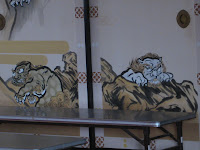

 landmark, an UNESCO World Heritage Site, was Tenryuji Temple. This is considered the most important Rinzai School Zen temple in Kyoto. Although the original structure dated back to 1339, wars and fires destroyed several reconstructions. The existing building dates from the late 19th century, during the Meiji period. The beautiful grounds include a karesansui (dry rock garden), typical of a Zen temple, as well as lush landscaping. Cherry and other fruit trees were near peak bloom as one can see from the photos.

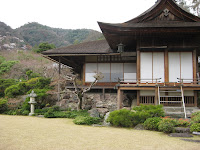

 Next was
  Okochi-Sanso Villa, the hilltop estate of the late movie actor Okochi Denjiro (1898-1962). The road we were walking on to reach the estate passed through the spectacular Sagano bamboo forest. We were able to visit several small shrines and view the exterior of his studio, before having tea in the main villa, now a museum. Many of Okochi's memorabilia were on display. He was best known for his samurai roles, as represented by the poster.


 After tea, we wandered through the estate and adjacent gardens before returning to the Keifuku Arashiyama train station area for a last look around. We had a chance to walk to the Hozu River, where we saw several technologically advanced rickshaws lined up to take passengers around the neighborhood.
We did some last minute shopping before boarding the train back to downtown Kyoto. Machiko guided us through the transfer to the subway at the Kyoto Train Station. The nearest metro stop was only a block or so from the Hearton.


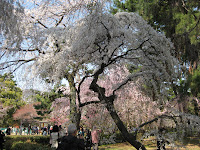
 We decided to spend the
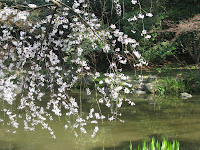

 remainder of the afternoon strolling the grounds of Kyoto Imperial Palace (Kyoto Gosho in Japanese). In our opinion, this park afforded us the best examples of fruit trees in full flower on this trip. It was a great place to people watch, too! Although this was a weekday, there were many locals and
tourists alike enjoying the day here.


OAT treated us to a fabulous farewell dinner at a shabu shabu
 restaurant, located in the Gion District of east Kyoto. The long table had four inductive-type range burners on which the servers placed large fondue-like pots used to cook our meals. Several of us shared each pot. While the broth was being brought to boiling, they served us appetizers of Japanese eggplant and pickle, followed by prawn and vegetable tempura. We then each placed our sukiyaki-like thinly sliced beef, vegetables, bean curd and noodles into the by-now boiling pots. A light dessert of strawberries and ice cream completed this meal. We were so stuffed! Note: first photo courtesy of Ray.
“E.C.” had suggested earlier that each of us prepare a haiku poem to be read to the group after tonight’s dinner. Machiko had passed around some sheets with guidelines on how to write haiku. We learned there are several acceptable formats for this genre of poetry. Most of us took the plunge and read our pieces to the group.


 The Gion District is the best known Geisha district in Kyoto. It is
 especially charming at night, especially during the cherry blossom season. Note the attractive utility cover. Machiko led the group through this historic preservation district, where the City of Kyoto has illuminated many of the picturesque streets and canals, including the resplendent cherry trees. In all, this walk was a nice finishing touch to this wonderful “Cultural Treasures of Japan” tour!
We could not believe this was our last full day in Japan! Time had flown by so quickly and we had done so much. This day and evening were packed with activities from beginning to end.
OAT arranged for several taxis to take us on a half-day excursion to the Arashiyama neighborhood, located in west Kyoto. We disembarked near the busy Keifuku Arashiyama train station, walked through attractive neighborhoods, and emerged into the tranquil hillside parks, to visit several significant attractions.


 The principal


 landmark, an UNESCO World Heritage Site, was Tenryuji Temple. This is considered the most important Rinzai School Zen temple in Kyoto. Although the original structure dated back to 1339, wars and fires destroyed several reconstructions. The existing building dates from the late 19th century, during the Meiji period. The beautiful grounds include a karesansui (dry rock garden), typical of a Zen temple, as well as lush landscaping. Cherry and other fruit trees were near peak bloom as one can see from the photos.


 Next was
  Okochi-Sanso Villa, the hilltop estate of the late movie actor Okochi Denjiro (1898-1962). The road we were walking on to reach the estate passed through the spectacular Sagano bamboo forest. We were able to visit several small shrines and view the exterior of his studio, before having tea in the main villa, now a museum. Many of Okochi's memorabilia were on display. He was best known for his samurai roles, as represented by the poster.


 After tea, we wandered through the estate and adjacent gardens before returning to the Keifuku Arashiyama train station area for a last look around. We had a chance to walk to the Hozu River, where we saw several technologically advanced rickshaws lined up to take passengers around the neighborhood.
We did some last minute shopping before boarding the train back to downtown Kyoto. Machiko guided us through the transfer to the subway at the Kyoto Train Station. The nearest metro stop was only a block or so from the Hearton.


 We decided to spend the


 remainder of the afternoon strolling the grounds of Kyoto Imperial Palace (Kyoto Gosho in Japanese). In our opinion, this park afforded us the best examples of fruit trees in full flower on this trip. It was a great place to people watch, too! Although this was a weekday, there were many locals and
tourists alike enjoying the day here.


OAT treated us to a fabulous farewell dinner at a shabu shabu

 restaurant, located in the Gion District of east Kyoto. The long table had four inductive-type range burners on which the servers placed large fondue-like pots used to cook our meals. Several of us shared each pot. While the broth was being brought to boiling, they served us appetizers of Japanese eggplant and pickle, followed by prawn and vegetable tempura. We then each placed our sukiyaki-like thinly sliced beef, vegetables, bean curd and noodles into the by-now boiling pots. A light dessert of strawberries and ice cream completed this meal. We were so stuffed! Note: first photo courtesy of Ray.
“E.C.” had suggested earlier that each of us prepare a haiku poem to be read to the group after tonight’s dinner. Machiko had passed around some sheets with guidelines on how to write haiku. We learned there are several acceptable formats for this genre of poetry. Most of us took the plunge and read our pieces to the group.


 The Gion District is the best known Geisha district in Kyoto. It is
 especially charming at night, especially during the cherry blossom season. Note the attractive utility cover. Machiko led the group through this historic preservation district, where the City of Kyoto has illuminated many of the picturesque streets and canals, including the resplendent cherry trees. In all, this walk was a nice finishing touch to this wonderful “Cultural Treasures of Japan” tour!
Tuesday, April 28, 2009
OAT Japan, Monday, March 30, 2009:
Second Full Day in Kyoto
This morning, the Hearton’s Patio Restaurant was jam packed again, this time with well-dressed business people. Since today’s touring was going to be more leisurely, we decided to wait a half hour for the room to clear. We passed the time checking our e-mails on one of the hotel’s computers.


 We began our tour with a drive to an older, well preserved neighborhood, located in east Kyoto. The prevalent architectural style reminded us of that of the Samurai-era Nagamachi Quarter in Kanazawa. Note the similar mud walls, window treatments, rockwork and roof tiles.


 Our next stop was the Ryoanji Temple, an UNESCO World Heritage Site. This Zen temple is best known for its karesansui (dry rock garden). The unknown designers, thought to be working in the 1400s, created a rectangular space composed of a field of white raked rocks. They placed 15 moss-covered boulders, placed in such a way that the only viewpoint where all 15 were visible was from a single location in the Kuri, or main hall. An article in the science journal Nature called this design concept medial-axis transformation (this assertion is open to controversy; the appeal of this garden may lie in its inate Zen simplicity).


 The surrounding gardens at Ryoanji Temple were quite spectacular as well.

 We finished this morning’s excursion with a visit to a countryside rapeseed or canola farm, where we learned about picking flowering plants for later use in a salad or cooking in various ways. We were given disposable plastic galoshes to place over our shoes due to the mud. We had fun wandering the fields with farmhands, who taught us to pick only those stems with budding flowers (mature flowers would have been too bitter in taste).


 The original itinerary had called for a cooking class today in a local community center. As it turned out, we assisted in preparing lunch in an intimate restaurant created in an old farmhouse near the canola farm. We learned to make simple sushi, which we added to the excellent meal prepared by staff.
 As one can see, parking is at a premium in Japan’s cities. We passed this mechanical parking garage as we walked near our hotel.
Dinner was on our own again, so we cast about for ideas. Several of the group raved about the Kushikura yakitori restaurant a short walk away a couple of nights earlier, so that sounded good to us. Irina joined us for dinner at Kushikura, which turned out to be delightful. Although their fixed price menus were on the expensive side, we were able to keep costs reasonable by ordering items a la carte.
This morning, the Hearton’s Patio Restaurant was jam packed again, this time with well-dressed business people. Since today’s touring was going to be more leisurely, we decided to wait a half hour for the room to clear. We passed the time checking our e-mails on one of the hotel’s computers.


 We began our tour with a drive to an older, well preserved neighborhood, located in east Kyoto. The prevalent architectural style reminded us of that of the Samurai-era Nagamachi Quarter in Kanazawa. Note the similar mud walls, window treatments, rockwork and roof tiles.


 Our next stop was the Ryoanji Temple, an UNESCO World Heritage Site. This Zen temple is best known for its karesansui (dry rock garden). The unknown designers, thought to be working in the 1400s, created a rectangular space composed of a field of white raked rocks. They placed 15 moss-covered boulders, placed in such a way that the only viewpoint where all 15 were visible was from a single location in the Kuri, or main hall. An article in the science journal Nature called this design concept medial-axis transformation (this assertion is open to controversy; the appeal of this garden may lie in its inate Zen simplicity).


 The surrounding gardens at Ryoanji Temple were quite spectacular as well.
 We finished this morning’s excursion with a visit to a countryside rapeseed or canola farm, where we learned about picking flowering plants for later use in a salad or cooking in various ways. We were given disposable plastic galoshes to place over our shoes due to the mud. We had fun wandering the fields with farmhands, who taught us to pick only those stems with budding flowers (mature flowers would have been too bitter in taste).


 The original itinerary had called for a cooking class today in a local community center. As it turned out, we assisted in preparing lunch in an intimate restaurant created in an old farmhouse near the canola farm. We learned to make simple sushi, which we added to the excellent meal prepared by staff.
 As one can see, parking is at a premium in Japan’s cities. We passed this mechanical parking garage as we walked near our hotel.
Dinner was on our own again, so we cast about for ideas. Several of the group raved about the Kushikura yakitori restaurant a short walk away a couple of nights earlier, so that sounded good to us. Irina joined us for dinner at Kushikura, which turned out to be delightful. Although their fixed price menus were on the expensive side, we were able to keep costs reasonable by ordering items a la carte.
Subscribe to:
Posts (Atom)