Monday, February 13, 2017

COAST WALK IN LA JOLLA

The walk along the La Jolla coastal cliffs is popular with locals and visitors.
We noticed one fella had a drone over the Children's pool observing the seals at close range. He had precise control over guiding the drone to various positions


Squirrels scammer along the cliff tops.

Pelicans hold court on the cliffs  as well


Artists are often seen painting along the seaside walk.

BALBOA PARK-JAPANESE GARDEN

 Paul and I visited Balboa Park on a pleasant afternoon in February.  The Japanese Friendship Garden (“the Garden”) is an expression of friendship between San Diego and its sister city, Yokohama. It illustrates two cultures and creates an immersive experience into Japanese culture. The Garden’s design is based on centuries-old Japanese techniques adapted to San Diego’s climate and plants and seeks to foster a relationship between humans and nature, providing a respite attuned to Japanese simplicity, serenity, and aestheticism.

The Garden sits on a 12-acre plot. It offers a variety of educational programs, exhibits, and festivals as well as accredited horticultural classes to enhance and deepen visitor appreciation for Japanese culture. As a valued community resource, it is well known for its unique setting, stone arrangements, koi ponds, water features, sukiya-style buildings and landscape.


Bonsai means tray planting and is the art of dwarfing trees or plants by pruning and training in containers.


There was an interesting display of Japanese ceramics on display in the pavilion


Tray made by Dot Kimura, a neighbor friend


Tea and sweets were served to guests after a tea ceremony
Japanese kimono
Details of this kimono

We also visited the  Museum of Photographic Arts which is one of the first museum facilities in the United States exclusively designed to collect and present the finest examples of photographic art, spanning the history of photography from the 19th century to the present day.  The museum’s has one of the largest photography collections in the country and is a destination for scholars, researchers and professional photographers.  There was an exhibit of some photographs by Ansel Adams.
Ansel Adams photo-Clearing storm, Sonoma County

Another interesting large photo was a large composite of hill views that took on the look of range of hills
Composite photo
Section of Composite photo with a "forest" of power lines

Wednesday, December 21, 2016

THE BALLAD OF PACIFIC BEACH

Pelican  Brass statue Pelican Brown    

The ballad was written by Jan Phillips and is accompanied by a sculpture of a pelican wearing a vest. The sculpture is by T.J. Dixon and James Nelson. Crystal Pier is the name of the pier adjacent to this Lifeguard Station. Pacific Beach is usually shortened to the term P.B. by the locals and tourists.
The text of the poem is on a plaque attached to the Pacific Beach Lifeguard Station.
It reads:

"The Ballad of P.B.

Pelican Brown was in search of a home
where he could have fun and relax
he looked for a beach that was pretty
and a sea that was swimming with snacks.

He flew up and down the long coastline
looking both far and quite near
then one day he knew he had found it
when his eyes saw the great Crystal Pier.

On the end was a big crystal ballroom
dancers came from all over the west
and since Pelican Brown loved to tango
he dressed up in his best velvet vest.

He fit right in with the others
tangoed many a night until dawn
Pelican Brown loved the beat of the music
and danced until the others were gone.

Then he's fly out and find him some breakfast
the happiest bird all around
and everyone loved when they looked up
and caught sight of Pelican Brown.

The dancing bird soon became famous
people came from all over to see
the great crystal ballroom and dance hall
and the pelican known as P.B.

Poem by Jan Phillips copywright Jan Phillips
Concept and sculpture by T.J. Dixon & James Nelson"


Crystal Pier
 It is the only pier on the California coast to have cottages for short term rent.

CHRISTMAS IN SAN DIEGO


BALBOA PARK DURING THE HOLIDAYS


There are several things to enjoy in Balboa Park during the holiday season.  The Timken museum features an annual display of handcrafted ornaments made back in the 1930s. 

  About 500 ornaments are hung on a Christmas Tree of all shapes and sizes: made of beads, sequins and gems. The ceiling showcases more of the hanging ornaments  along with some ornaments in cases.


Outdoors in back of the organ pavilion in Balboa Park there is a display of several Nativity scenes that were made more than 70 years ago and were recently restored.  On Sunday afternoon Christmas music was played on the organ and visitors could also join in singing carols.  The nearby International Houses featured holiday cookies and treats.  Santa’s sleigh and reindeer are also on display.


During the holidays Crystal Pier in Pacific Beach is decorated with Christmas wreaths,  a tree and lights.  The pier was opened in 1927 in hopes of encouraging investors to buy  property in Pacific Beach.   The pier was repaired after  serious storm damage in 1983.  It is the only pier on the California coast to have cottages for short term rental. 


Another popular holiday activity is to see one of the 3 Nutcracker productions in San Diego.  We saw the San Diego Ballet Dance Company version that features in international cast of dancers and also spotlights San Diego School of Ballet’s children from all over the county.


The San Diego Bay Parade of Lights is another holiday tradition by the boating community.  This year the boats were decorated to fit this year’s theme “It Began with a Roar-San Diego Zoo celebrates 100 Years.”


Sunday, November 20, 2016

SAN DIEGO MUSEUM OF ART


On a recent visit to  the San Diego Museum of Art Paul and I saw an extensive exhibit on the life and architectural works of Louis Kahn.  It was titled The Power of Achitecture. It included over 200 objects related to Kahn's selected buildings and projects in the form of architectural models, plans, original drawings, photographs, films and more. With complex spatial compositions and a mastery of light, Louis Kahn's architecture is regarded as a touchstone of 20th century modernism.
Kimball Art Museum,  Ft. Worth, Texas. 
Louis Isadore Kahn (born Itze-Leib Schmuilowsky) (March 5, 1901 – March 17, 1974) was an American architect,[2] based in Philadelphia. After working in various capacities for several firms in Philadelphia, he founded his own atelier in 1935. While continuing his private practice, he served as a design critic and professor of architecture at Yale School of Architecture from 1947 to 1957.
From 1957 until his death, he was a professor of architecture at the School of Design at the University of Pennsylvania. Kahn created a style that was monumental and monolithic; his heavy buildings for the most part do not hide their weight, their materials, or the way they are assembled. Louis Kahn's works are considered as monumental beyond modernism. Famous for his meticulously built works, his provocative proposals that remained unbuilt, and his teaching, Kahn was one of the most influential architects of the twentieth century. He was awarded the AIA Gold Medal and the RIBA Gold Medal. At the time of his death he was considered by some as "America's foremost living architect."[3]

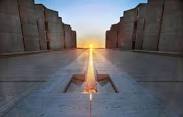
•                The Salk Institute, La Jolla, California.The two laboratory blocks frame a long view of the Pacific Ocean accentuated by a thin linear fountain that seems to reach for the horizon. It has been named "arguably the defining work" of Kahn.


National Assembly Building in Dhaka, Bangladesh was Kahn's last project, developed 1962 to 1974. Kahn got the design contract with the help of one of his students at Yale Univesity who worked with him on the project. The Bangladeshi Parliament building is the centerpiece of the national capital complex designed by Kahn, which includes hostels, dining halls, and a hospital. According to Robert McCarter, author of Louis I. Kahn, "it is one of the twentieth century's greatest architectural monuments, and is without question Kahn's magnum opus."

Another area in the museum highlighted art of the 20th century
Still-life with fish by Emil Filla
The first decades of the twentieth century witnessed a schism in the arts as painters and sculptors in Europe and the Americas began to break with academic traditions. Rallying under the banner of expressive freedom and an independence from established institutions, these artists began to explore new social realities, and the even more radical concept of a purely abstract art. Adding to this transatlantic transmission of ideas was an unprecedented internationalism. A new era of travel and communication would, for example, lead Mexican modernist Diego Rivera to Paris. Conversely, wars, suffering, and the dream of a new life led ever more European artists to emigrate to the United States.

by Diego Rivera
by Salvador Dali
Tracing a trajectory through a century of art, from the School of Paris to Surrealism and Pop, the paintings and sculptures on view do not present a traditional survey divided by national schools. Instead, this display combines artists from Europe, the United States, and Latin America to highlight the international aspects of modernism. In so doing, the installation showcases the special strengths of the Museum’s collection of modern and contemporary art together with a    select group of loans.


by Frank Stella
A collage with elements of Picasso'a Guernica

Photo of Guernica by Picass