Tuesday, March 23, 2010

"Staycation" Drive, Anza Borrego, March 2010

Thursday March 18, 2010

We decided to make our annual late winter trek to Anza Borrego Desert State Park, to see the wildflowers. Expectations were high, since this El Niño rain season had brought 7.41 inches to the Anza Borrego Desert State Park Visitor Center (as of March 15), at least 50 percent above normal.

We drove through Ramona, to snap a few photos to add to our recent blog, then stopped at the Dudley's Bakery and Café in Santa Ysabel. They had changed their operation quite a bit since our last visit in March 2009. Before, they kept their inventory behind the counter, where personnel would slice the loaves on request. Now, they have racks of pre-sliced bread arranged in front of the counter, to allow customers to pick their own loaves. (We suspect this approach was an attempt to save labor costs). We selected three: our favorite, apple pecan; a new Louisiana maple pecan; and a rosemary savory bread. Current prices are $4.65 per 24-ounce loaf; if one buys four loaves, the fifth one is free. Too bad we do not have sufficient freezer room to accommodate five loaves!

On our way to Julian the first time today, we noticed swatches of bright yellow daffodils. We learned that Julian was celebrating a Daffodil Festival the March 20-21 weekend. The last remnants of snow were gone and temperatures in Julian were in the 60s F.

We decided to take the Wynola Road cutoff to reach SR 78 and Banner Grade. County Road 3 (Yaqui Pass) took us to Borrego Springs past the now defunct Casa del Zorro Resort/Borrego Ranch Resort & Spa. We first checked out the picnic tables at Christmas Circle Community Park. However, this was a warm, sunny day with an intense sun and essentially no shade. We decided to head to the Visitor Center via Palm Canyon Road.

Even this weekday, the Visitor Center was swarming with people. But the grounds were in spectacular bloom. The painter indicated that Borrego Springs was hosting a plein aire art festival that coming weekend.

After our visit we decided to have our lunch among the palms in a picnic area located immediately south of the Visitor Center parking lot. Many of the tables were well-shaded and we dined in comfort. (Note: there is no parking or standing allowed next to the picnic area, but it's only a short walking distance from the main parking lot).

We spent early afternoon heading east on Palm Canyon Road (County Road S22), north on Pegleg Road and west on Henderson Canyon Road. The best flowers were on the east portion of Henderson Canyon Road, where the ground was hummocky and the drainage was good. Note the ranger-led group in the background of the second photo.
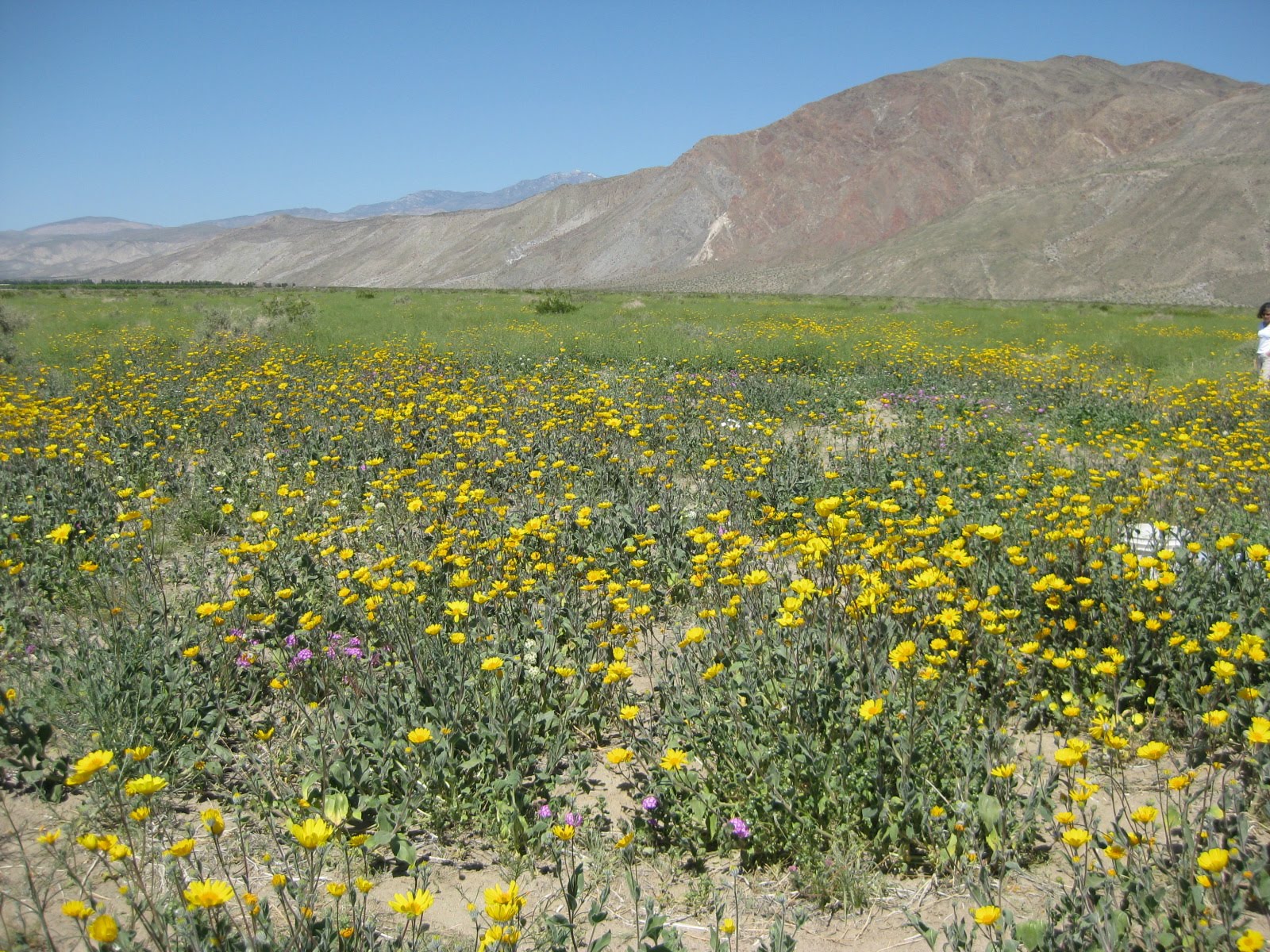
The comparatively cool, wet winter had resulted in an unusually abundant crop of field mustard (by now bereft of flowers), resulting in a green groundcover in the less well-drained areas, especially those along Henderson Canyon Road just east of Di Giorgio Road.

We took a run up Di Giorgio Road to its terminus at Coyote Canyon where we had seen beautiful flower displays in the past, but this year they were not especially noteworthy (perhaps the recent warmer weather improved things). Additionally, the sand looked a bit too treacherous for our little Corolla.

Our final stop in the Borrego area was a little fruit stand located at the northeast corner of Di Giorgio and Henderson Canyon roads, where we bought a large bag of tangelos for $3.

We returned to Julian via Banner Grade to indulge in a tasty, sinful treat-slices of Dutch style crumb-topped apple-berry pie a-la-mode at our favorite pie shop, The Julian Pie Company. There are several other pie shops in Julian, some perhaps better known, but we have always enjoyed the personable staff here. By the way, the pie was delicious and we recommend it highly. Note: they were mourning the passing of one of the founders of the shop, Keith Smothers, 69.

We finished the drive by driving past nearly-full Cuyamaca Lake and still snow flecked Cuyamaca Peak to Interstate 8 and home. Approximate mileage: 200.

Tuesday, March 16, 2010

"Staycation" Drive to Ramona

Friday, January 8, 2010

We decided to make Ramona our destination for today’s “staycation” road trip. Our friend Jack Brandais suggested taking the Pomerado Road turnoff eastbound from Interstate 15. Turn left at the first light onto Highland Valley Road. This narrow two-lane road took us through San Pasqual Valley and along the flanks of 2,140-foot Starvation Mountain, to hook up with State Routes 67 and 78 to Ramona. The good rains we had during December 2009 had already greened up the countryside. Note: Highland Valley Road is steep and windy, especially the climb from San Pasqual Valley and Highland Valley to the Starvation Mountain highlands. Do exercise caution on this portion of the drive.

Photo of Starvation Mountain courtesy of Summitpost.org.

Our objectives were to browse the antique shops, have lunch, and visit historical buildings in the old stagecoach stop town.

We arrived in the unincorporated town about 10 a.m., to give us ample time to browse the shops. But our first stop was the Ramona Chamber of Commerce, 980 Main Street. We were hoping to find a map of historical sites much as Fallbrook’s Historical Museum had done for Fallbrook, but no such luck. However, there are several significant buildings we were able to identify through on-line research and in the field. These were the focus of our afternoon wanderings.

Ramona is another case where suburban strip mall development, mostly to the west, has adversely affected the old downtown. Many storefronts were vacant and available for lease. The Great Recession of 2008-9 had exacerbated the economic situation wherein some historical preservation projects had been halted due to the lack of funding.

Only some of the antique stores along Main Street were open, but the ones that opened their doors were well worth visiting.

We enjoyed browsing the Ramona Antique Fair, also known as the Squash Blossom Trading Co., 738 Main Street. It offers an extensive selection of antiques offered by sub-lessees, as well as Native American and Mexican art. Adjoining the Antique Fair was Old Town Candy Co., 734 Main Street. As the name implies, it is an old-fashioned candy store with cylindrical buckets filled with stick candies.

Across the street was Victoria Supply Co., 711 Main Street, a seller of stoves, decorative glass and other hardware. It seemed to specialize in reproductive decorative arts of the Victorian, and Arts and Crafts eras. Looking at the store’s façade, we can tell this business occupies a former bank building and several commercial storefronts dating back to the 1920s.

It was time for lunch, so we decided to go Mexican at La Cocina (the Kitchen in Spanish), located across from Victoria Supply Co. at 681 Main Street. They offered combination plates of enchiladas or rolled tacos, Spanish rice and beans at a cheap $4.95. The food was good and authentic, and popular with Anglos and Latinos alike. (Note: this place is small and quite popular, so one should try to be seated about 15 minutes before noon). The café occupies what appears to be a 1920s or earlier commercial building with a tin ceiling that has been preserved to this day.

After lunch, we sought out several historical attractions located in the 600 and 700 blocks of Main Street. One of the most significant individual buildings is the Ramona Town Hall, 729 Main Street. This imposing Romanesque/Mission Revival adobe building, finished in 1893, was designed by one of San Diego’s most famous architects, William S. Hebbard. The building has been under restoration following a 1995 arson fire. As of this writing, the Great Recession has essentially halted work on the building. Do peruse their excellent Web site for its history and the 2009 dedication of the structure as a historically significant site by E Clampus Vitus. Note: the building is also listed on the National Register of Historic Places and is a California State Landmark.

The Town Hall served as the only movie theater in town until 1947 with the opening of the Ramona Theatre, 626 Main Street. This well-restored Retro Art Deco building is now the Ramona Mainstage, currently a live performance house and nightclub. As of this writing, it appears to be on sound economic footing after years of decline as a cinema.

Our last stop was the Guy B. Woodward Museum, 645 Main Street. Hours: Friday-Sunday, 1-4. Admission $4 for a guide-led tour; $3 for a self-guided tour. The Amos Verlaque House, built in 1886 and placed on the National Register of Historic Places, is the most noteworthy building in the museum complex. It is the only adobe house in existence in the United States designed in the French-Provincial style. The second-generation museum director, Ken Woodward [with Doug in the upper left photo], took us on a complete tour of the premises, which took about an hour and a half. The house is furnished in Victorian period. Note the beautiful dining room and the French Provincial kitchen.

A couple of unusual features are a wine cellar (reflecting the Verlaques’ French heritage), now the museum store; and a north-facing veranda painted in light blue, allegedly to fend off flies and other insects.

Other buildings and exhibits, some of which were moved on-premises, include a one-room schoolhouse (left photo), blacksmith, cowboy bunkhouse (above), an extensive hat collection and a one-cell jail. The Woodward Museum is a fun place to visit and we would recommend it highly.

Note: the Ramona Pioneer Historical Society (RPHS) has archived an extensive collection of historical materials at the Museum. The fee for a four-hour research session ranges from $25-100, plus the cost of duplicating materials. Obviously, this service is intended only for the serious researcher. The RPHS produced a book, Historic Buildings of the Ramona Area by Russell Bowen, printed in 1975. Copies are available in the San Diego City Library System. When we have a chance to review this book, we will update this blog posting.

Amos, the son of prominent San Diegan Theophile Verlaque, ran the adjacent general store that also served as a stagecoach stop on the stage line between Old Town San Diego and Julian. The general store, in somewhat modified form, exists today as the CATT Farm and Ranch Supply, 629 Main Street.

This row of rural mail boxes lies just west of town.

We headed home by way of SR 78 and 67 to Scripps Poway Parkway, I-15, SR 52 and I-5. Round trip from Pacific Beach was about 80 miles.

Tuesday, March 9, 2010

"Staycation" Drive to Valley Center, San Diego County

Thursday, January 7, 2010

Our son’s family gave us a $50 restaurant gift card that we could use at numerous restaurants in San Diego County, so we decided to use it on a “staycation” drive to Valley Center. Our choice for lunch was The French Market Grille, located in Rancho Bernardo, a community in North San Diego. The comfortable dining room reminded us of a bistro in the French countryside. Marie had grilled scallops Provençale done in a basil sauce ($15.75), and Doug had grilled rare lamb chops bathed in a rosemary sauce ($16). Both entrées were delicious. The owner, Patrick Halcewicz, stationed himself at a table near the bar where he could oversee his operation. After lunch we chatted with him while he was dining on his steak sandwich with pommes frites. He was originally from Paris and the cooking reflected this authenticity. He has established a second restaurant with a similar menu, Hexagone, located on Laurel Street in the Bankers Hill neighborhood of San Diego.

After lunch, we continued north on Interstate 15 to the Via Rancho Parkway exit, and headed northeast on Bear Valley Parkway. [Note: the name Bear Valley, we learned later, is highly significant to the history of Valley Center.]

We continued north past the heart of Valley Center to the Valley Center History Museum, located at 29200 Cole Grade Road, next to the county branch library. We recommend exploring the Museum’s well-designed Web site in advance of a visit. The original name of the settlement was Bear Valley, named after a giant grizzly bear that was killed in the area in 1866. See link for the Bear connection to Valley Center.

Noteworthy exhibits at the Museum include a taxidermy mounting of a grizzly bear; an overhead exhibit of experimental aircraft dating back to the 1910s, the outhouse-sized Lilac Post Office, once the smallest post office in the United States; a Betty Crocker display (Agnes White, the home economist who inspired the cooking legend Betty Crocker, lived in Valley Center and was buried in the local cemetery); a replica of a 500-year-old Native American village; and various artifacts dating from the 1840s.

Museum hours are 1-4 p.m. Tuesdays through Saturdays; admission is free and ample on-site parking is available.

We finished this afternoon’s outing at the Valley Center Farmers’ Market, located on the grounds of the Valley Center Community Center, 28246 Lilac Road. This Certified Farmers’ Market is held every Thursday afternoon (check their Web site for hours).

Our route home took us along scenic Lilac Road and Old Castle Road back to I-15, SR 56 and I-5. Round trip distance: about 80 miles from Pacific Beach.

Saturday, January 2, 2010

La Jolla Photo Essay, January 2, 2010

It was a beautiful day, so we decided to do a walk along the La Jolla coast, followed by a drive to the Mt. Soledad Memorial Cross.

We began the walk at the Children's Pool, which is now a sanctuary for the harbor seal population. People are allowed only limited contact. Note the abundant bird life, especially pelicans.

We contnued north toward La Jolla Cove, a designated swimming area. Along the way, we encountered more seals and pelicans.

Here is a view of La Jolla Cove, with an aloe plant in the foreground.

Kayaking is a popular activity below La Jolla Cave, the northern end of our walk. The bird population is truly amazing!


The Mt. Soledad Memorial Cross commemorates the war dead, dating back to at least World War I. The Mt. Soledad Memorial Association is now in charge of maintaining the memorial.


Here is a closeup of one of the World War I plaques.


The site affords some of the most panoramic views in San Diego.

Monday, November 9, 2009

“Staycation” Drive to Fallbrook

Since Doug’s diagnosis, we have been looking for day trips to take to “get out of the house”. One town we had not visited in decades is Fallbrook. It’s located in extreme northern San Diego County about five miles west of Interstate 15 along County Routes S13 and S15. The most direct way to the old downtown (the part that is of interest to us) is to take S13 (Mission Road) from I-15 west over rolling countryside to Main Avenue. Round trip distance from Pacific Beach is about 118 miles for the total loop; one-way distance to the Village of Fallbrook is about 55 miles.

The best weekday to visit Fallbrook is Thursday, when both museums in town are open without appointments being necessary.

Mission Road and Main Avenue are now part of Historic U.S. Highway 395 that refers to the original narrow two-lane road that once connected Temecula, Rainbow, Fallbrook, Escondido and points south. The San Diego County Department of Public Works began installing the historic designation highway signs in 2008.

We found tree-shaded on-street parking on Main Avenue near Alvarado Street and strolled first to the Fallbrook Area Visitor Bureau, 111 W. Alvarado Street. Armed with maps and brochures, we first headed to the Fallbrook Gem and Mineral Society Museum, 123 W. Alvarado Street. The principal emphasis of their gem and mineral collection is the tourmaline mines in San Diego County. They also have an impressive mineral collection illuminated by ultra-violet light in a curtained-off back room.

The area located along Main Avenue north of Alvarado Street to Mission Road has a strong Latino flavor. It was fun strolling through the El Toro Market, a large, authentic Mexican-style bodega, located at 337 N. Main Avenue. We had never seen so many fresh tortillas in one place! It reminded us of bodegas we saw in Oaxaca with their extensive selection of mole sauce.

Fallbrook is remaking itself as an art center. The Fallbrook Art Center, 103 S. Main Avenue, is the headquarters for the Fallbrook Center for the Arts Group. The exhibit space is in a former 1961 Rexall Drug store, which was converted to the art gallery/museum in 1994. The Café des Artistes occupies the original Rexall lunch counter with one of the few authentic soda fountains remaining in San Diego County.

We decided to have lunch at the Café, which features Mediterranean-style cooking. We both had a panini/acorn squash soup combination plate ($9.50), followed by a split of a sinful flourless chocolate cake ($4.50). Delicious! Note the mural of famous artistes by Brett Stokes where Doug is sitting.

Although the Art Center was not officially open to visitors that day (it was being set up for a juried art show), the management allowed us to take a quick look at the exhibit anyway.

The Fallbrook Center for the Arts Group also sponsors a variety of outdoor public art, consisting of murals and bronze sculptures. The mural is that of a sepia photo depicting historic Downtown Fallbrook in the 1920s.

Village Square Park, 102 S. Main Avenue is a pleasant public park and outdoor performance space amidst quaint shops and restaurants. It is also the location for Fallbrook Farmer's Markets held Fridays and Sundays, along with the Art Center's parking lot on Sundays.

We had some time to kill before our next attraction opened to visitors, so we drove to the 1887 First Methodist Episcopal Church, 318 W. Fig Street. It sits on a prominent site west of the historic downtown. The First Christian Church of Fallbrook now occupies this beautifully kept Italianate-Victorian church.

We drove through conventional suburban sprawl (malls and multiple-family housing) lining S13 (South Mission Road) to reach the Fallbrook Historic Society Museum, 260 Rocky Ridge Road. The entrance to the Museum is off of Hill Street, just south of the west end of Rocky Ridge Road. The Museum comprises two buildings open to visitors: the two-level Main Museum and the Pittenger Country House.

The centerpiece of the main exhibit space is the working model train lined with 12 miniature reproductions of some of Fallbrook’s most prominent Victorian-era buildings, many of which do not exist anymore. The model steam engine is unusual in that it reflects a design current in the 1880s.

The California Southern Railroad (later incorporated into the Atchison, Topeka and Santa Fe Railroad during a reorganization) once connected Oceanside with Temecula, with the right-of-way following the Santa Margarita River to a rail depot and stage stop in Fallbrook, then continuing through Temecula Canyon. Washouts from heavy rains in 1884, 1891 and 1916 created major problems for rail operations, which were eventually forced to shut down. (See “The Fallbrook Line” by Richard V. Dodge for a summary of the travails the railroad operators faced.

The museum had some unusual items unique to the Fallbrook area. For example, there was a floor-standing clock constructed entirely of avocado wood.

The smaller Ford Room occupies the lower level of the main building, Its exhibits include two antique Ford automobiles, a Model T and a Model A; a barbed wire collection; and a display detailing the history of U.S Highway 395.

The Reverend William Pittenger Country House, built in 1890, lies just south of the museum and is also open to the public. Reverend Pittinger was the first pastor to lead the First Methodist Episcopal Church on Fig Street. Although his primary residence was the 1892 Parsonage (still located across from the church at 135 Mission Road and now occupied by the Fallbrook Healthcare Foundation), he built the farmhouse as a retreat. The various rooms are furnished in different period styles ranging from the 1880s to the 1920s. The docent even played a turn-of-the-20th Century Victrola record player that required a crank to operate!

The Historical Society recently constructed a replica of a “California-style” barn that will be used for displaying farm implements and meeting space. This structure is located to the east of the main museum, accessed by a separate entrance off Rocky Crest Road.

On the way home, we decided to visit one of the many nurseries in the Fallbrook area. One of the more attractive is the Myrtle Creek Nursery, located at 2940 Reche (pronounced “richee”) Road a few miles east of town in the bucolic Live Oak Park area. Note the water wheel and garden setting of the place. The 1940s farm house now serves as a store, offering produce, preserves and gourmet gifts as well as plant related items.

We completed our loop by taking Gird Road south to SR 76, back to I-15, then home. This was a pleasant day, indeed!